
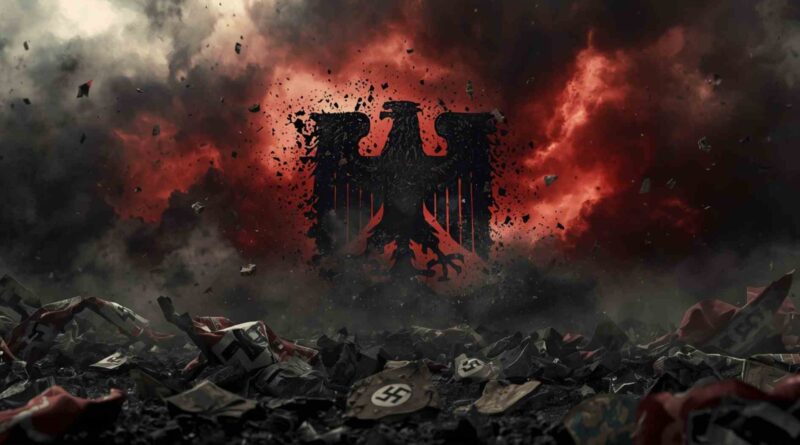
What Were the Fatal Flaws of Fascism in Germany?
Historians, students, and curious readers have asked this question for decades: what were the fatal flaws of fascism in Germany that made its collapse not just possible, but inevitable? The Third Reich lasted only twelve years 1933 to 1945 yet in that time it caused more destruction than almost any regime in recorded history. Understanding why it failed is not just an academic exercise. It tells us something important about power, ideology, and what happens when a system is built on lies, violence, and the elimination of rational thought.
This article breaks down the core structural, ideological, and strategic failures that doomed German fascism from the inside out.
What Were the Fatal Flaws of Fascism in Germany: A Full Breakdown
German fascism better known as National Socialism or Nazism was not simply a political movement. It was a total system: a way of organizing the state, the economy, the military, and even private life around a single ideology. That totalizing ambition was, paradoxically, one of its greatest weaknesses.
When everything depends on one system, one leader, and one set of ideas being correct, any crack in the foundation becomes potentially fatal. Nazi Germany had many such cracks and most of them were built in from the start.
1. Fatal Flaw: The Cult of the Leader Left No Room for Error
Hitler’s regime was structured around the Führerprinzip the “leader principle.” Every decision ultimately flowed upward to Hitler. Ministers, generals, and party officials competed for his favor rather than coordinating effectively with each other.
This created a system where telling the truth became dangerous. Subordinates learned quickly that Hitler did not want bad news. By the mid-war years, military commanders were routinely withholding accurate assessments of battlefield losses, resource shortages, and strategic failures because delivering honest reports could mean dismissal or worse.
The result was a feedback loop of delusion. Hitler made decisions based on distorted information, and those decisions were then implemented without meaningful pushback, even when they were catastrophically wrong. The invasion of the Soviet Union in 1941, the declaration of war on the United States, and the refusal to allow strategic retreats on the Eastern Front are all examples of decisions that competent advisors might have tempered if anyone had been empowered to do so.
Historian Ian Kershaw, in his landmark biography of Hitler, described this as “working towards the Führer” a system where officials anticipated and amplified Hitler’s will rather than correcting it. That is not governance. That is a machine designed to accelerate its own mistakes.
2. Fatal Flaw: Racial Ideology Undermined Practical Competence
The Nazi regime made racial purity a prerequisite for participation in German public life. This sounds abstract until you consider what it meant in practice.
Jewish scientists, doctors, lawyers, engineers, economists, and academics were expelled from their professions en masse after 1933. Germany lost an extraordinary concentration of intellectual talent almost overnight. Among the exiles were figures like Albert Einstein, physicist Lise Meitner, and psychologist Kurt Lewin. Many of them went on to contribute directly to Allied war efforts.
The atomic bomb project the Manhattan Project was staffed significantly by European Jewish scientists who had fled Nazi persecution. Germany had the theoretical groundwork to develop nuclear weapons first. Racial ideology ensured it did not.
This was not a side effect of Nazi policy. It was the policy. And it illustrates one of the fatal flaws of fascism in Germany most clearly: a system that prioritizes ideological purity over competence will consistently make worse decisions than one that does not.
The same logic applied in the military. Officers who questioned orders, expressed doubts, or came from disfavored backgrounds were sidelined in favor of ideologically loyal but often less capable alternatives.
3. Fatal Flaw: The Economy Was Built on Plunder, Not Production
Nazi Germany’s economic “miracle” of the 1930s the rapid reduction of unemployment and the apparent recovery from the Great Depression was largely illusory. It was built on deficit spending, rearmament, and the systematic looting of occupied territories.
Historian Adam Tooze, in his exhaustive study “The Wages of Destruction,” demonstrated that the German economy was in serious structural trouble even before the war began. The regime was spending on armaments at a rate it could not sustain through domestic production alone. It needed conquest to feed itself quite literally.
When occupied territories were exhausted, when supply lines stretched across Europe and into the Soviet Union, and when Allied bombing began targeting German industrial capacity, the economic model collapsed. Germany was fighting a war of attrition against opponents with far greater industrial output the United States, the Soviet Union, and the British Empire while running an economy that had no sustainable foundation.
The plunder of Jewish property, forced labor from concentration camp prisoners, and extraction from occupied France, Poland, and the Soviet Union bought time. It did not buy survival.
4. Fatal Flaw: Strategic Overreach and Fighting Everyone at Once
Adolf Hitler had a coherent enough strategic vision in the early years absorb German-speaking territories, intimidate weaker neighbors, and avoid a two-front war. The problem is that he eventually abandoned every one of those principles.
By December 1941, Germany was simultaneously at war with the Soviet Union, the British Empire, and the United States. This was not the result of circumstances beyond Hitler’s control. Germany declared war on the United States four days after Pearl Harbor a decision that had no military logic whatsoever. America had not attacked Germany. There was no treaty obligation that required it. Hitler simply believed his own propaganda about American weakness and Jewish control of US politics.
Fighting a three-front war against opponents with vastly superior resources and manpower was an objective impossibility. Germany’s military planners knew it. The famous “Barbarossa” plan for the Soviet invasion assumed a campaign of weeks, not years. When the Soviet Union did not collapse on schedule, Germany had no coherent backup plan.
Strategic overreach is a recurring fatal flaw in fascist systems because the ideology demands perpetual expansion. Fascism cannot stabilize it must always be conquering, always growing, always proving its superiority through force. That imperative eventually brings it into conflict with opponents it cannot defeat.
5. Fatal Flaw: Terror as Governance Has Diminishing Returns
The Nazi state maintained control through the Gestapo, the SS, the concentration camp system, and constant surveillance. Fear was the primary tool of domestic governance.
This worked to a point. It suppressed open dissent, crushed organized opposition, and made most ordinary Germans compliant out of self-preservation. But terror as a management system has serious long-term costs.
It eliminates honest communication (as discussed above). It destroys initiative people stop taking productive risks when any mistake could be punished catastrophically. It breeds a kind of learned helplessness in the population, where people stop thinking critically or creatively about problems. And it generates resentment that, while suppressed, never disappears.
By the final years of the war, even Nazi officials were hedging their bets hiding assets, making quiet contacts with Allied representatives, positioning themselves for the aftermath. The system of terror that had seemed so permanent in 1938 was visibly disintegrating by 1944.
6. Fatal Flaw: Propaganda Cannot Substitute for Reality Indefinitely
Joseph Goebbels was a genuinely skilled propagandist. The Nazi communications apparatus was sophisticated, pervasive, and highly effective at shaping public perception in the short term.
But propaganda has limits. You can control what people say. You can control what newspapers print. You can control what films show. You cannot, in the end, control what people experience with their own eyes. When German cities began burning under Allied bombs, when casualty letters started arriving, when food rationing tightened and then tightened again, the gap between the propaganda narrative (“Germany is winning, Germany is strong, Germany will prevail”) and lived reality became impossible to bridge.
By 1944 and 1945, civilian morale in Germany was collapsing despite not because of the propaganda. Goebbels himself recorded in his diary a growing despair about the gap between what the regime was saying and what Germans knew to be true.
A system built on a false account of reality will eventually be defeated by reality itself. This is perhaps the most universal lesson of the Nazi collapse.
7. Fatal Flaw: The Moral Collapse That Corrupted Everything
This last flaw is harder to quantify but impossible to ignore. Nazi Germany committed crimes the Holocaust, the mass murder of Soviet civilians, the systematic starvation of prisoners of war on a scale that consumed enormous resources, distorted military priorities, and ultimately united the world against it.
The Holocaust, for example, required hundreds of thousands of personnel, vast infrastructure, and significant logistical resources at precisely the moment when Germany was losing the war and desperately needed every available asset. The murder of six million Jews and millions of others was not a sideshow to the Nazi project it was central to it. And it was one reason why the Allies could not negotiate, could not accept any outcome short of total defeat.
When your ideology demands crimes of this magnitude, you guarantee that your opponents will fight to the end rather than accept your survival.
Frequently Asked Questions
Why did fascism in Germany fail so quickly compared to other authoritarian regimes?
German fascism was unusually aggressive in its expansion and unusually rigid in its ideology. Other authoritarian regimes like Franco’s Spain survived for decades partly because they avoided catastrophic military overreach. Hitler’s regime tied its survival to perpetual conquest, which meant that any major military defeat threatened the entire system. The war that fascism started was ultimately the war that destroyed it. Add to that the sheer scale of moral crime involved, and there was no path to a negotiated survival.
Could German fascism have survived if it had not invaded the Soviet Union?
This is one of the most debated counterfactuals in modern history. Some historians argue that Germany’s economic model required continued expansion and looting, making further war virtually inevitable. Others suggest a more cautious Hitler could have consolidated control over Western Europe and reached a stalemate with Britain. What most historians agree on is that the Soviet invasion was the single greatest strategic blunder it turned a winnable regional war into an unwinnable global one. Even so, the internal flaws of the system the leader cult, the racial ideology, the reliance on terror would likely have produced a different kind of collapse eventually.
Did ordinary Germans understand that the regime was failing before the end?
Increasingly, yes. Historian Robert Gellately and others have documented how German public opinion shifted significantly after the defeat at Stalingrad in early 1943. Privately expressed doubts multiplied, black market activity increased, and the elaborate shows of public enthusiasm became visibly more forced. The regime’s own internal reports the SD Meldungen show that by 1944, public morale was deeply pessimistic. Most Germans did not openly resist, but many had privately concluded that the war was lost.
What role did corruption within the Nazi Party play in its collapse?
A significant one. The Nazi system created massive incentives for corruption officials competed for resources, territory, and influence with little meaningful oversight. Hermann Göring, for example, accumulated personal wealth and art on an extraordinary scale while heading an air force that was increasingly outmatched. This kind of institutional rot degraded efficiency, created internal rivalries that undermined coordinated action, and meant that resources intended for the war effort were regularly diverted for personal gain. It was a predictable consequence of a system with no independent judiciary, no free press, and no rule of law.
Is there a lesson from the fatal flaws of fascism in Germany that applies today?
Historians are cautious about direct comparisons, and rightly so every historical moment is specific. But some structural lessons are broadly applicable. Systems that concentrate power in a single leader without accountability tend to amplify errors rather than correct them. Economies built on extraction rather than production are fragile. Regimes that silence honest internal criticism eventually lose touch with reality. And ideologies that treat some humans as less than human tend to produce the kind of moral catastrophe that unites the world in opposition. These are not just lessons about 1933 to 1945. They are lessons about how power works.
Was the collapse of Nazi Germany inevitable from the beginning?
Not in the strict sense history rarely works that way. There were moments where different decisions might have produced different outcomes, at least in the short term. But the structural flaws were deep enough that some form of serious crisis was almost certain. A system built on racial fantasy, leader worship, economic plunder, and the elimination of honest feedback is not a stable system. It was always operating on borrowed time. The war simply accelerated and exposed what was already broken at the foundation.
Conclusion: Understanding the Fatal Flaws of Fascism in Germany
The fatal flaws of fascism in Germany were not external accidents. They were features of the ideology itself built into its structure, its leadership model, its economic logic, and its moral framework. A regime that could not tolerate honest information, that expelled its most capable minds on racial grounds, that needed constant conquest to survive economically, and that committed crimes requiring total Allied commitment to its destruction that regime carried the seeds of its own collapse from the beginning.
Understanding this is not just a matter of historical interest. It is a reminder of what happens when ideology replaces reality as the basis for governance, and when the capacity for self-correction is systematically destroyed.
Explore more on LarkMagazine